Java4Shell (CVE-2026-114938): Are Your Java Servers Affected and What to Do Now
A memory-corruption bug in Java's Base64 decoder allows unauthenticated remote code execution on some servers. Check three conditions to see if you are affected, then patch step by step.
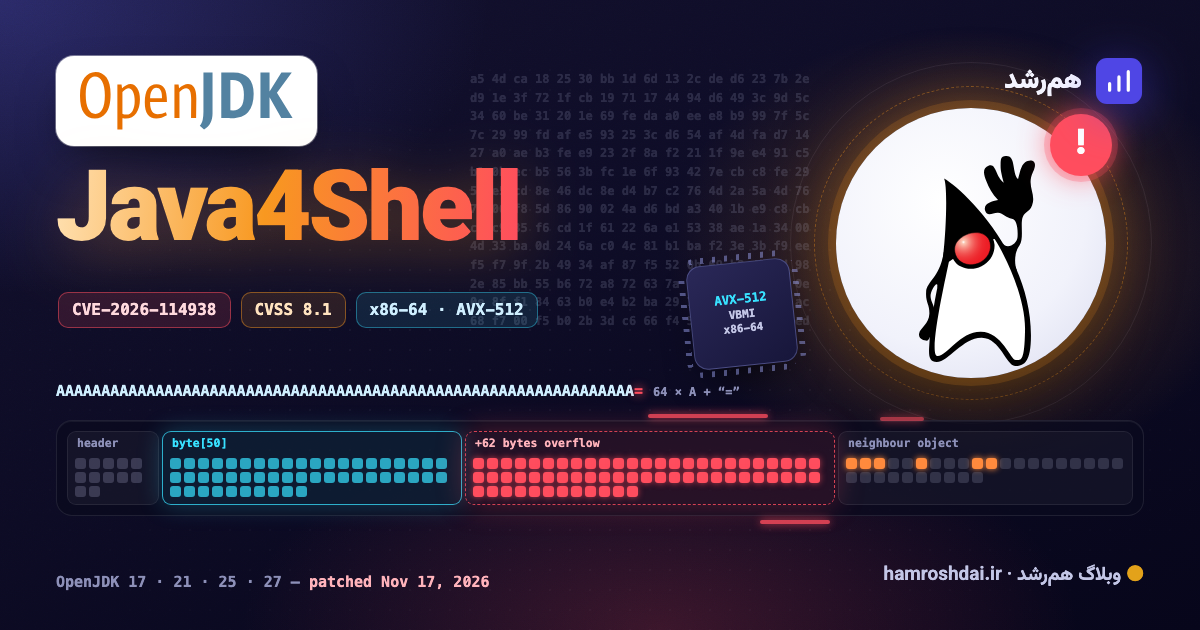
On November 17, 2026, Oracle and the OpenJDK project shipped fixes for CVE-2026-114938, a memory-corruption bug in Java's Base64 decoder that its finders named Java4Shell. A remote attacker with no account can send a crafted Base64 string to an affected server, corrupt the JVM's heap, and in the worst case run code on it. The same day, CISA urged organizations to patch immediately.
Not every Java server is exposed, though. The bug needs a specific CPU feature, a specific range of JDK builds and a default JVM setting. This guide explains how it works, how to tell in a few minutes whether your servers are affected, and what to do today.
What was released on November 17
Three primary sources tell the story:
The OpenJDK Vulnerability Advisory of 2026/11/17 lists ten OpenJDK CVEs fixed in this release. CVE-2026-114938 is the most severe: component
hotspot/compiler, CVSS 3.1 score 8.1, marked for the 17, 21, 25 and 27 release lines.Oracle's Critical Security Patch Update for November 2026 contains 655 security patches in total, 11 of them for Oracle Java SE. Its risk matrix rates CVE-2026-114938 as remotely exploitable without authentication, with high attack complexity and high impact on confidentiality, integrity and availability.
The researchers at Calif, who reported the bug, published a technical write-up the same afternoon. They score it 9.2 under CVSS 4.0.
The Canadian Centre for Cyber Security classifies it as a heap-based buffer overflow (CWE-122) and said on November 17 that it was not aware of active exploitation at that time.
How a Base64 decoder breaks a memory-safe language
Java checks every array access, which is why memory corruption is rare in Java code. But the JVM itself contains low-level code. To decode Base64 faster, HotSpot uses hand-written routines (intrinsics) built on AVX-512 VBMI instructions on x86-64 processors that support them.
According to Calif, the bug is in the part of that routine that handles the last few characters. Their example is 64 A characters followed by a single =. For that 65-character input, Java allocates a 50-byte result array. After decoding the first 64 characters, the routine mishandles the stray =, computes a negative output length, and turns it into a full 64-byte write: 62 bytes land past the end of the array. Java does reject the input in the end, but by then neighbouring objects in memory may already be damaged.
From there Calif describes two outcomes:
Information leak: reading memory around the corrupted object, in the style of Heartbleed, which can expose secrets such as keys and tokens.
Remote code execution: grooming the heap so the overwrite takes control of the process.
Two points matter for risk assessment. First, Base64 is everywhere: authentication headers, tokens, file uploads and network messages. Calif demonstrated pre-authentication RCE in the default configurations of Keycloak, Atlassian Jira and Confluence, JFrog Artifactory, Jenkins and PingFederate, and post-authentication RCE in Apache Kafka, Solr, Elasticsearch, Gerrit and Spinnaker. They say the list is not exhaustive and that they also exploited sample apps built on Spring Boot and Apache Struts. Second, there is no universal exploit: each application needs its own chain, and a failed attempt can crash the JVM.
Are you affected? Three conditions
A Java process is at risk only when all three of these are true. The conditions come from Calif's write-up and the Keycloak team's guidance.
The JDK build is in the affected range. Calif says OpenJDK 17.0.6 and newer builds are affected until the fix. This includes distributions built from OpenJDK: Eclipse Temurin, Amazon Corretto, Azul Zulu, Microsoft Build of OpenJDK, BellSoft Liberica, SAP SapMachine and Red Hat's builds.
The CPU exposes AVX-512 VBMI. Examples: Intel Xeon Ice Lake, Sapphire Rapids, Emerald Rapids and Granite Rapids, and AMD EPYC/Ryzen Zen 4 or newer. ARM64 servers, including Graviton and Apple Silicon, are not affected.
Base64 intrinsics are on, which is the default, and the JVM has not been limited to AVX2.
Oracle and the Canadian Cyber Centre list these affected and fixed versions:
Line | Affected (up to and including) | Fixed |
|---|---|---|
Java 17 | 17.0.21.0.3 (from 17.0.6) | 17.0.21.1 |
Java 21 | 21.0.13.0.3 | 21.0.13.1 |
Java 25 | 25.0.5.0.3 | 25.0.5.1 |
Java 27 | 27.0.1.0.3 | 27.0.1.1 |
Java 8 Enterprise Performance Pack | 8u511b33-perf | 8u513-perf |
Standard Java 8 and Java 11 builds are not marked for this CVE in the OpenJDK advisory. They are listed for other CVEs in the same release, so they still need this month's update.
A virtual machine counts too: what matters is whether the hypervisor exposes the CPU flag to the guest, which is why the check below has to run on the real host or node.
What to do today: a practical checklist
1. Find every Java runtime. CISA notes that JDKs and runtimes bundled in third-party applications, container images and appliances often do not show up as separate entries in software inventories. Look inside images and vendor products, not just at the system java.
2. Check the CPU on each host or node. Calif's check on Linux:
grep -m1 '^flags' /proc/cpuinfo | tr ' ' '\n' | grep -E '^(avx512f|avx512bw|avx512vbmi|bmi2)$'All four flags must appear. On Kubernetes, run it on the node, not on your laptop.
3. Update to a fixed build. Use 17.0.21.1, 21.0.13.1, 25.0.5.1 or 27.0.1.1, or your vendor's equivalent. Rebuild container images rather than patching running containers. Distributions shipped at different speeds: as of November 18, Tenable reported fixed builds from Amazon Corretto and Azul Zulu, with Eclipse Temurin rolling out. Check your vendor's page before you assume.
4. If you cannot update yet, disable the vulnerable path. Start the JVM with:
-XX:-UseBASE64IntrinsicsThis turns off only the accelerated Base64 code; Red Hat calls it the preferred interim mitigation. The alternative -XX:UseAVX=2 disables all AVX-512 use. Both flags are for x86-64 only: Calif warns that Java on ARM does not recognise them and will fail to start.
5. Verify the running JVM, not the config file. Keycloak's advice applies to any Java service:
jcmd $PID VM.flags -all | grep -F UseBASE64IntrinsicsThe expected output is UseBASE64Intrinsics = false. Seeing the variable in an environment file is not proof.
6. Prioritise internet-facing services, especially login and identity systems such as Keycloak, CI servers such as Jenkins, and anything that decodes Base64 before authentication. Keycloak has already moved its 26.8 images (tags latest, 26.8, 26.8.2, 26.8.2-3) to a fixed runtime.
7. Watch for warning signs. CISA lists unexpected JVM crashes, rogue runtimes and suspicious Java processes as indicators. A burst of hs_err_pid crash files on a public service deserves attention this week.
Exploitation status
As of November 18, Tenable reported that several groups had built working exploits without releasing them, that GreyNoise had seen exploitation attempts without confirmed success, and that the CVE was not yet in CISA's Known Exploited Vulnerabilities catalog. Calif's public proof of concept only shows whether a JDK and CPU combination triggers the bug; it does not take over the process.
That is a narrow window. The trigger is short and public, the exploitation method is documented, and the affected applications are among the most common in enterprise networks. Treat the gap between "no confirmed exploitation" and "mass exploitation" as days, not months.
The bigger lesson: code you never needed
Two details from Calif's write-up stand out. They say they found the bug with an AI coding agent in about an hour, built the first exploit in two more, and spent less than $200 on tokens. And the vulnerable code is a performance optimisation that most applications, decoding a few hundred bytes at a time, barely benefit from.
Calif's conclusion is worth taking seriously: for security, ask "what can we delete?" as often as "what can we build?". In practice that means keeping runtimes current as a routine rather than a project, knowing which JDK every service actually runs, and switching off features you do not use. Teams that can answer "which Java version runs where?" in minutes will handle the next Java4Shell much better than teams that need a week to find out.
For more practical guides on software and security, see the Hamroshd blog.
Sources
OpenJDK Vulnerability Advisory: 2026/11/17, OpenJDK Vulnerability Group
Critical Java Vulnerability Requires Immediate Patching, CISA, November 17, 2026
AL26-029: Critical vulnerability impacting Oracle Java, Canadian Centre for Cyber Security
Java4Shell (CVE-2026-114938) FAQ, Tenable
Featured image: OpenJDK logo (Oracle trademark, from Wikimedia Commons) and Duke, the Java mascot_waving.svg) (BSD licence, Wikimedia Commons)
Related articles

npm Supply Chain Attacks in 2026: How to Protect Your Team
ChainDrop reached more than 400 npm packages, and in November hijacked packages ran code without any install script. Why familiar defences fall short, and which settings to turn on this week.
Gemini 4 Carbon Is Here: What an AI Built for Cyber Defense Means for Teams
Google gave Gemini 4 Carbon to cyber defenders first and opened it to all paying developers on 10 November. What its security numbers show, and how smaller teams can use it safely.
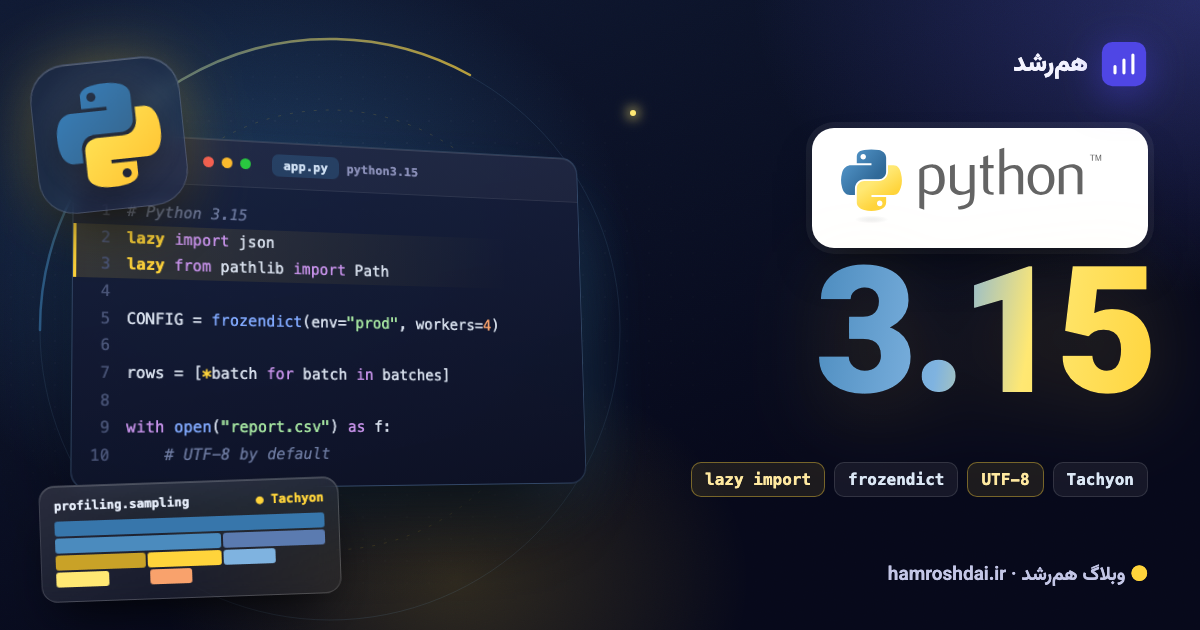
Python 3.15 Is Out and 3.10 Is Retired: A Practical Upgrade Guide for Teams
Python 3.15 brings lazy imports, frozendict, the Tachyon profiler and UTF-8 by default, and Python 3.10 no longer gets security fixes. What changed, what can break and where to start.