Qwen4-Max Is Here, but Closed: API Flagship or Open Weights Like Mistral Large 4?
Alibaba's Qwen4-Max brings 2.4 trillion parameters, a 1M-token context and cheaper API prices, but no downloadable weights. How it compares with the open-weight Mistral Large 4, and four questions for choosing.
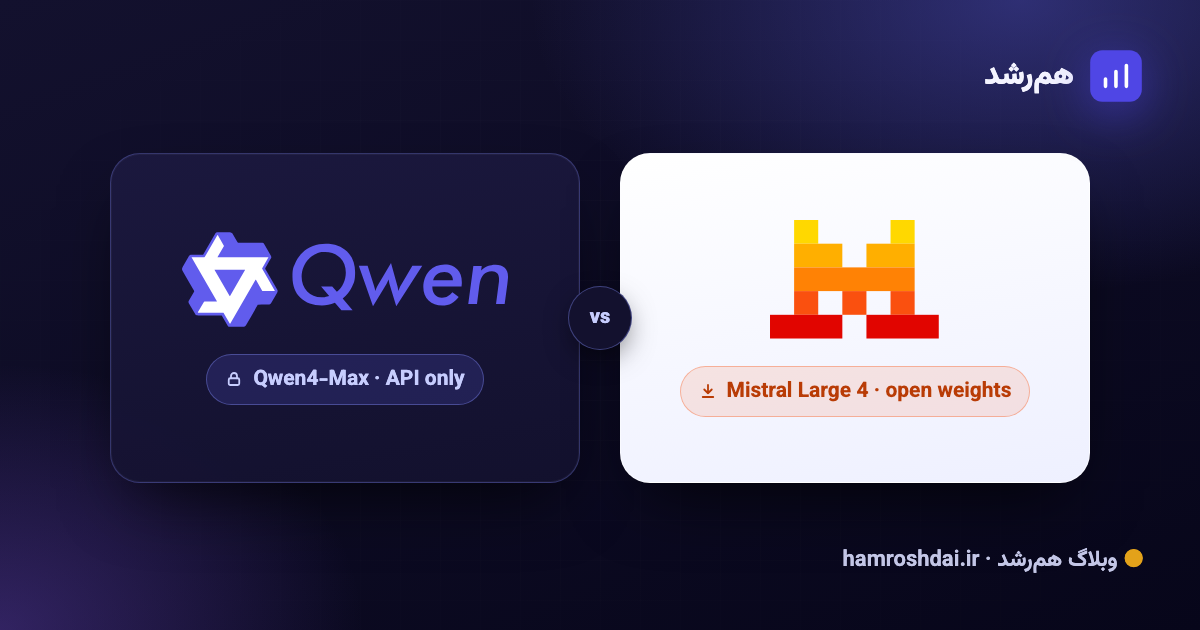
On November 16, 2026, Alibaba made Qwen4-Max generally available. It is the largest and most capable model in the Qwen family so far, and it is cheaper to call than its predecessor. It is also closed. For a family that became the default base for thousands of community fine-tunes, that last detail matters as much as any benchmark.
Two and a half weeks earlier, Mistral went the other way and published the weights of Mistral Large 4, a model of similar ambition. So teams choosing a large model this month face a real fork: rent a frontier model through an API, or download one and run it yourself. This article sets out what each release actually offers and gives a practical way to decide.
What Alibaba released
According to Alibaba's announcement, Qwen4-Max is a sparse Mixture-of-Experts (MoE) model with 2.4 trillion total parameters, of which 71 billion are active for each token. It understands images natively and accepts up to one million tokens of context, enough for a large codebase or a stack of contracts in one request.
The main claims:
Efficiency. On Work360, Alibaba's own benchmark of tasks across 721 professional fields, Qwen4-Max beats Qwen3.8-Max while using 35% fewer tokens in its high-effort reasoning mode. TechNode reports that the average task cost on that benchmark fell from RMB 26.58 to RMB 11.16, about 58% lower.
Fewer active parameters. Decrypt notes that the model activates 71 billion parameters per token, against 95 billion for Qwen3.8-Max, so a very large model costs less compute per token.
Rankings. Alibaba says it placed 6th on Code Arena, a leaderboard built on head-to-head votes for AI-built websites.
Long-running agents. The company's showcase includes a 48-hour, four-iteration agent run in chemistry research and a manufacturing demo in which programming time for a workpiece fell from about 475 minutes to 24.
The showcases are examples Alibaba chose itself, not independent tests, and Work360 is a proprietary benchmark. Treat the numbers as the vendor's claims until your own evaluations confirm them.
Price, access and the closed-weights catch
Qwen4-Max is available through QwenCloud (API and the Token Plan) and in Alibaba's own apps, QwenWork and Qwen Studio. Decrypt reports API prices of $1.50 per million input tokens and $4.50 per million output tokens, a 25% cut from the previous flagship's $2 and $6. Repeated input served from the automatic cache costs $0.075 per million tokens, which makes workflows that resend the same long context much cheaper.
The catch is that the weights are not published. You cannot download the model, fine-tune it on your own hardware or run it on a private network. That is a notable change of tone: Decrypt cites a Hugging Face count of 151,448 Qwen-based derivative models, and Alibaba had opened the weights of Qwen3.8-Max. The company says smaller open-weight Qwen4 models will be released "soon" but has not given their sizes or a date.
The open-weight alternative: Mistral Large 4
Mistral released the weights of Mistral Large 4 on October 29, 2026, after an API-only preview. The model card on Hugging Face describes:
About 1 trillion total parameters and 49 billion active per token (52 billion including embedding and output layers), with 128 routed experts, 4 active per token, plus one shared expert.
Native image input, a 1M-token context window and fluency in more than 160 languages.
Three reasoning efforts (low, medium and high), so you can trade depth for cost on each request.
Recommended serving with vLLM or SGLang, plus an NVFP4 checkpoint with a smaller memory footprint for NVIDIA Blackwell GPUs.
The licence is the Mistral Ecosystem Open-Weight License, a modified MIT licence. Use, modification, fine-tuning and commercial use are allowed. The one condition is that a business selling the model as a service (Model-as-a-Service) needs a separate commercial licence from Mistral. Mistral also says Large 4 leads open-weight models on Terminal-Bench 4.0 with 41% and scores 48% on the Artificial Analysis Coding Agent Index. Like Alibaba's figures, these are the vendor's own reported results.
Side by side
Qwen4-Max | Mistral Large 4 | |
|---|---|---|
Released | November 16, 2026 | Weights October 29, 2026 |
Total / active parameters | 2.4T / 71B | ~1T / 49B (52B with embeddings) |
Context window | 1M tokens | 1M tokens |
Image input | Yes | Yes |
Weights | Closed (API and apps only) | Open, Mistral Ecosystem licence |
How you run it | QwenCloud API, QwenWork, Qwen Studio | Your own GPUs (vLLM/SGLang) or a managed host |
Published API price | $1.50 in / $4.50 out per 1M tokens | Depends on where you host it |
How to choose for your team
The right answer depends less on leaderboards than on four practical questions.
1. Where is your data allowed to go? If contracts, customer records or source code cannot leave your network, an API-only model is out by definition, however good it is. Open weights are the only way to run a model of this class entirely inside your own infrastructure.
2. Do you really have the hardware? Open weights are not free to run. At 4-bit precision, a trillion parameters is roughly 500 GB of weights before you count the memory for long contexts. The model card's own serving examples assume a multi-GPU node, with 8 GPUs as the example. If you cannot run that, or rent it, a managed API is the realistic option.
3. What does a finished task cost? Compare cost per completed task, not price per token. Alibaba's argument for Qwen4-Max is exactly this: fewer tokens per task and cheap cached input. For a self-hosted model, the cost is GPU time and engineering hours, which only pays off at steady, high volume.
4. How much dependence can you accept? With an API, the vendor can change prices, rate limits or the model itself. With open weights you keep a fixed copy that no one can withdraw, but you also own updates, security patches and monitoring.
What to do this week
Build a small test set from real work. Collect 20 to 50 tasks your team actually does (summaries, code reviews, extraction from documents) with examples of a good answer.
Run both kinds of model on it. Score the results yourself, including in Persian or Arabic if that is the language you work in. Vendor benchmarks rarely cover it.
Measure cost per finished task, including retries and human corrections.
Write down your data rules first. If something must not leave your servers, that decision comes before any comparison.
Watch for the smaller Qwen4 open models. If they arrive with good quality at a size you can run, they may change the calculation for many teams.
More analysis of AI models and tools is on the Hamroshd blog.
Sources
Alibaba Unveils Qwen4-Max: New AI Teammate for Work, Creativity, and Discovery (Alibaba Cloud, November 16, 2026)
Alibaba launches Qwen4-Max with lower API prices and a million-token context window (TechNode, November 16, 2026)
Alibaba's Qwen 4 Max Leads China's AI Agent Race—But You Can't Download It (Decrypt, November 16, 2026)
Mistral Large 4 (Le Chonk) is now open weight (Mistral AI, October 29, 2026)
mistralai/Mistral-Large-4-1T-A52B model card (Hugging Face)
Image: Qwen logo (Alibaba Cloud / QwenLM, Apache 2.0) and Mistral AI logo (public domain), via Wikimedia Commons; trademarks of their owners.
Related articles
Siri AI Opens to All Developers: Is Your App Ready for AI Assistants?
On 3 November Apple opened Siri AI to every app, though App Store releases wait until spring. How App Intents, entities and app skills work, and what product teams can do now.
Gemini 4 Carbon Is Here: What an AI Built for Cyber Defense Means for Teams
Google gave Gemini 4 Carbon to cyber defenders first and opened it to all paying developers on 10 November. What its security numbers show, and how smaller teams can use it safely.
When Should an AI Agent Ask Before It Acts? A Practical Guide to Approval Gates
An agent that can send emails or issue refunds holds the keys to the building. Two simple questions tell you which actions it can take alone and where a human should approve first.